




Identifying best practices, synergies, and building a comprehensive CE/IS development model for industrial parks

RA3 employs the outputs of RA1 and RA2 to design the development model. Both theoretical and empirical evidence are considered in the definition of the framework, as the knowledge of territorial characteristics and weaknesses is useful to ensure the feasibility of model designing. This activity is linked to the keywords ‘Circular Entrepreneurship’ and ‘Industrial Symbiosis’.
The in-depth analysis of recognized best practices will allow to identify factors enabling the birth and development of circular businesses. Furthermore, existing synergies among different production sectors will highlight the most effective exchange of materials for increasing levels of IS in the industrial areas and identify most suitable interventions which could maximise collaborative behaviour among firms. Based on this and on the evidence provided by the literature review, a development model will be constructed.
Duration: Year 1 Bimester 6 + Year 2 Bimesters 1–2
Status: Completed
Lead: RU1 — University of Naples “L’Orientale”
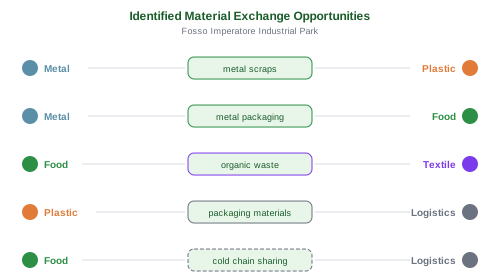
Identification of existing synergies among different production sectors, mapping potential material exchanges and resource sharing opportunities to highlight the most effective pathways for increasing levels of Industrial Symbiosis in the industrial areas.
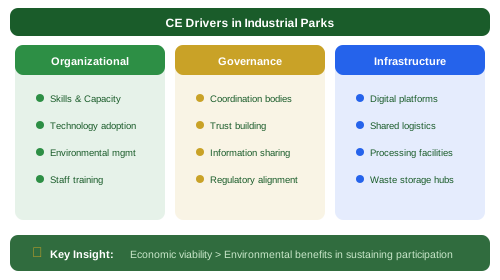
Identification of CE drivers in Industrial Parks, defining the set of factors enabling circular entrepreneurship and Industrial Symbiosis experiences through analysis of national and international best practices and enabling conditions.
Definition of Development Models allowing to increase the ‘symbiotic potential’ of the reference context, exploiting available synergies, structures, facilities and flows, and integrating all findings into an actionable framework for the IP.
Identification of existing synergies among different production sectors. The analysis mapped potential material exchanges and resource sharing opportunities across the Fosso Imperatore IP and surrounding territory, revealing that successful initiatives balance top-down coordination with bottom-up participation, avoiding both excessive centralization and complete reliance on spontaneous self-organization.
Identification of CE drivers in IP. The research found that economic viability proves more influential than environmental benefits in sustaining participation — circular initiatives succeed when they reduce costs or generate revenue, with environmental gains functioning as supplementary rather than primary motivations. A catalogue of potential interventions was developed, organized across organizational mechanisms, governance structures, and infrastructure investments.
Definition of Development Models allowing to increase the ‘symbiotic potential’ of the reference context, exploiting available synergies, structures, facilities and flows. The model emphasizes phased implementation beginning with visible, low-risk exchanges to build organizational capacity before attempting complex multi-party arrangements. Only three interventions from the full catalogue passed the feasibility screening: digital waste matching platforms, logistics coordination, and aggregated collection.

Report detailing the Development Model — Identification of the set of factors enabling circular entrepreneurship; a systematic collection of the main international and national best practices in the fields of IS and CE in industrial areas; Definition of interventions and incentives boosting synergies and cooperative behaviours among firms.