



Building a robust theoretical background on IS/CE concepts, methodologies, tools, and indicators

RA1 provides the theoretical foundation for the entire CE_IPsa project. This "Studying" phase constructs a robust theoretical background on the main techniques, methodologies and tools for studying, planning and measuring the evolution of Industrial Symbiosis (IS) and Circular Economy (CE) in Industrial Areas. The activity refers to the keywords "Circular Economy" and "Industrial Symbiosis".
The review is structured around four main research dimensions: (1) the conceptualization and evolution of IS and CE, (2) the methodological approaches and tools developed for implementation, (3) the measurement and evaluation methods for assessing symbiotic and circular production patterns, and (4) the roles and interactions of actors involved in circular production systems. This systematic collection of contributions provides the empirical and theoretical bedrock upon which all subsequent Research Activities are built.
Duration: Year 1 — Bimester 1
Status: Completed
Lead: RU2 — University of Messina
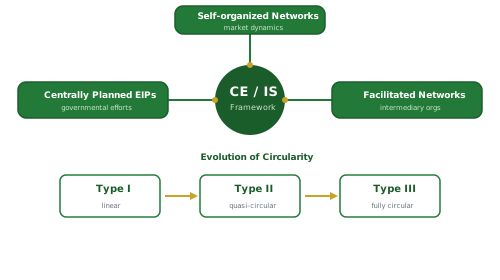
Definition of current Industrial Symbiosis and Circular Economy concepts and types, tracing the evolution from pre-1990s frameworks through current paradigms and identifying three primary IS implementation models: self-organized networks, centrally planned Eco-Industrial Parks, and facilitated networks.
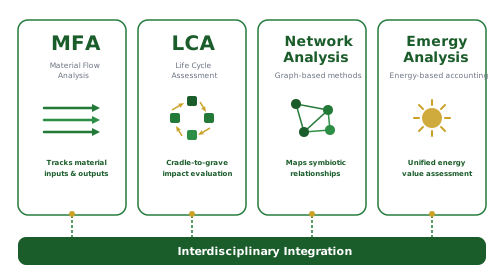
Analysis of the main methodological approaches and tools developed for implementing and studying IS, including Material Flow Analysis, Life Cycle Assessment, Network Analysis, Agent-Based Modeling, and strategic assessment methodologies.
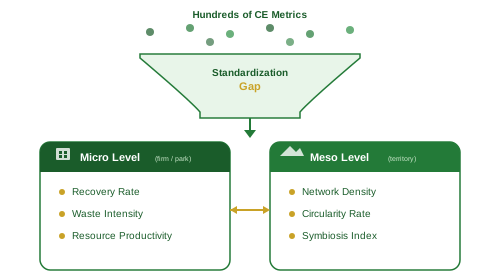
Identification of the main approaches (methods and indicators) for measuring and evaluating symbiotic and circular production patterns, critically reviewing hundreds of CE metrics across multiple frameworks to assess their applicability at micro- and meso-level.
Systematic review of the literature on the actors involved (firms, companies, governments) in relation to the circular production issue, analyzing roles, interactions, and the complex dynamics between economic incentives, regulatory frameworks, trust mechanisms, and information availability.
A comprehensive definitional framework was developed tracing the evolution of Circular Economy and Industrial Symbiosis from early concepts to current paradigms. The review identified three primary IS implementation models: (a) self-organized networks emerging from market dynamics, (b) centrally planned Eco-Industrial Parks (EIPs), and (c) facilitated networks supported by intermediary organizations. The analysis demonstrates that successful symbiotic relationships depend not merely on technical feasibility but on complex interactions between economic incentives, regulatory frameworks, trust mechanisms, and information availability.
A critical analysis of the main analytical tools for IS/CE implementation was conducted, covering Material Flow Analysis (MFA), Life Cycle Assessment (LCA), Network Analysis, and Agent-Based Modeling (ABM). The review highlighted that the most advanced research emphasizes interdisciplinary integration, combining quantitative metrics with qualitative insights and leveraging advanced computation. Each methodology was assessed in terms of applicability, data requirements, and suitability for different spatial scales.
A systematic review of hundreds of CE metrics across multiple frameworks was performed. A critical challenge was identified: the lack of standardization across methodologies, with most indicators requiring comprehensive data unavailable in SME contexts. The review provided the basis for selecting and developing indicators applicable at the micro- (industrial park) and meso- (territorial) levels, informing the indicator framework later developed in RA4.
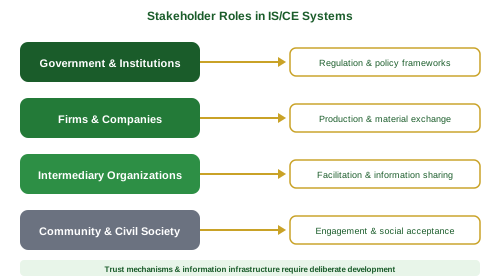
The systematic review mapped the roles of actors involved in circular production systems, including firms, public administrations, intermediary organizations, and community stakeholders. The analysis revealed that information infrastructure and trust mechanisms require deliberate development rather than emerging spontaneously from technical opportunity, and that phased implementation beginning with visible, low-risk exchanges builds organizational capacity before attempting complex multi-party arrangements.
Integrated Report on the State of the Art — A systematic collection of contributions of the literature on industrial symbiosis, industrial metabolism and symbiotic solutions and tools applicable, indicators of symbiosis and circularity, and role of actors and communities.
—
RA2 — Context Analysis →